Tag: knowledge

  • Wisdom Bulk Up

    Wisdom Bulk Up

    Read

    Psalm 147:12–20; Proverbs 1:1–7; James 3:13–18

    Focus

    ‌The reverence of the LORD is the beginning of knowledge; but fools despise knowledge and instruction.

    Proverbs 1:7 Lamsa Version

    the wisdom from above is first pure, then peaceable, gentle, willing to yield, full of mercy and good fruits, without a trace of partiality or hypocrisy.

    James 3:17 NRSVue

    Devotion

    ‌George Lamsa’s “reverence of the LORD” is unique among translations, as it seems every other English translation uses fear. Yet, the underlying understanding of fear in Proverbs 1:7 is fear based upon reverence of God, rather than other types of fear.

    ‌Why one pursues knowledge seems to becoming more critical as time goes on. People are pursuing knowledge for power and money. Yes, there many pursuing their dreams, but how much of that dream is about money and power, rather than a fulfillment of oneself?

    ‌In ancient times, wisdom and knowledge were often intertwined. In our modern days, we have started to understand (wisdom) that all the facts and data points do not mean that we make wise (or God honoring) decisions.

    ‌James notes that Godly wisdom has characteristics that modern knowledge does not. It is not that knowledge is bad, by no means. It is that we are seeing the consequences of what happens when knowledge is separated from Godly wisdom.

    ‌How do we bulk up our wisdom? Reading the Scriptures is a big one. We are blessed to have access to the Scriptures with nearly 900 English translations (not to mention all the targeted versions of each).

    ‌What reading the Scriptures often don’t give us are prescriptions for how to do what, and that is okay. James 3:17 (see Focus) gives us descriptions for what Godly wisdom looks like. How that is lived out is up to us as we wrestle with reading the Scriptures and living life among people who believe differently than we do.

    Reflection

    ‌Do you see differences between wisdom of the world and Godly wisdom? How do you navigate the differences?

    Act

    ‌Find a Bible reading plan (if you don’t have one), even one that just covers a book (like James or Proverbs) and start it.

    Prayer

    ‌Gracious God, we thank you that you have provided the Scriptures so that we might understand you better, and be better reflection of God-honoring lives. As John called Jesus the Word, may we recall that the Word presented in the Scriptures is not to be left on a shelf, or isolated from the world outside of the pages. Help us to improve our wisdom in navigating the world in light of your Word. Amen.

  • Greater or Lesser Than Evils

    Greater or Lesser Than Evils

    Read: Psalm 119:41–48, Deuteronomy 10:10–22, James 2:14–26

    Focus

    ‌No one ever accomplishes good by means of evil, because they are themselves conquered by the evil. On the contrary, evil is corrected by good.

    St. Barsanuphius the Great

    You believe that God is one; you do well. Even the demons believe—and shudder.

    James 2:19 (NRSVue)

    It is a good exercise to ask, what is evil? Why do we categorize certain perspectives, actions, or even people as evil? Often, what we judge as evil is really about what we view as normative, as if normal was automatically good (or evil, for that matter).

    Devotion

    ‌In the US, today is Halloween. It is a combination of many traditions, and always comes with a plethora of arguments as to whether Christians should observe it, participate in any type of recognition of it (Truck ‘n’ Treat, Harvest Party, and the like), or stay in a holy huddle.

    ‌In Christian circles, 31 October has some Western Christian specific applications. In a few traditions, this (though really beginning at sunset) is the beginning of The Allhallowtide season, which is a time set aside in the church year for first, observation of the Saints (known & unknown, martyred and not) who have gone before us to their Heavenly Reward. It concludes with All Souls Day, which is an observation of all Christians who have gone before (and we won’t talk about Saints and saints).

    ‌For those of us of the Protestant traditions (in other words, not Roman Catholic or a myriad of Orthodox), 31 October is also Reformation Day, the general agreement that the Reformation began with Martin Luther starting an argument about the sufficiency of Christ by nailing his proposals (theses) to the gate of churches in the German city of Wittenberg. To be clear, the undercurrents of the Reformation were already moving (from an historical viewpoint) in Europe (with martyrs, too). Luther’s dramatic postings (though in course with cultural expectations) created a great story.

    ‌The secular and non-Christian aspects that we are experiencing for Halloween are, truly, a perversion and syncreticism of pre-Christian, Christian, and post-Christian belief structures. Just a side not, perhaps instead of assaulting Halloween, we do something different (and I’m not talking about Harvest Parties and Trunk ‘n’ Treats). Not that I necessarily have an idea, but much of the angst and outrage borders on evil, which St. Barsanuphius was warning us about.

    ‌As we watch functionally innocent children walk around asking for candy—who are dressed up as ghosts, stereotypical witches, super heroes, and what have you—we need to ask ourselves why we perceive a particular costume as good or evil. It’s not that I, for example, don’t have opinions, but I have had to spend time pondering why a particular costume is “evil” versus “good”. This is not about relativism. This is about my perspective of normal masked with what is “good”.

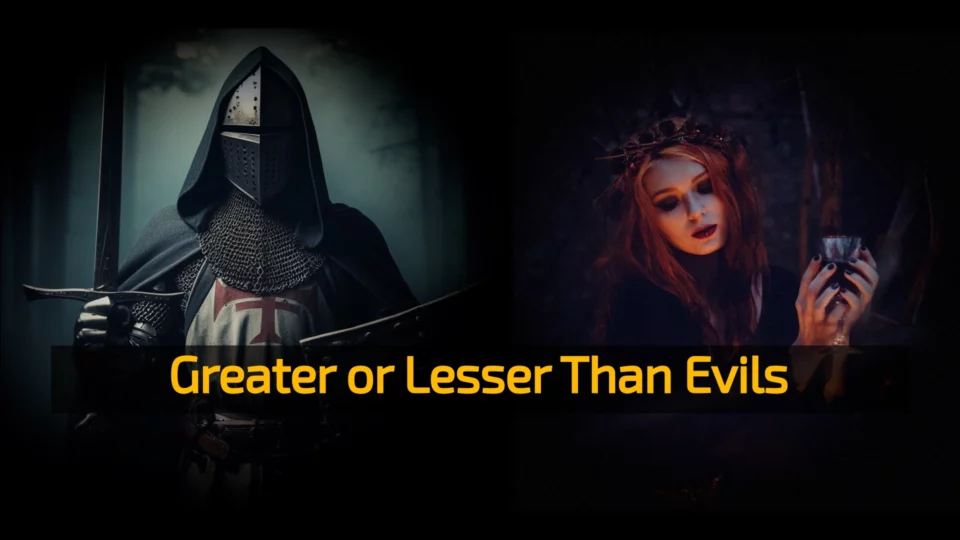
    ‌If there were two kids, one dressed up like a vampire and one dressed up as Knight Templar (a knight order during the Crusades in the Near East), my automatic emotional response would be vampire=bad, and Templar=good. However, if I were born and raised from the Near East (regardless of faith tradition), I might be very hard pressed to figure out which is evil, because the Templars were not good from a Near East perspective, because they came in conquest (motives aside) for generations.

    ‌If I, as a parent, knew that my neighbor was from the Near East, and dressed my child up as a Knight Templar (assuming my child wanted that), am I doing evil to my neighbor? Am I loving my neighbor?

    ‌This is not about incidental errors, but actions performed despite knowledge. Which brings us to the words of James. The demons James refers to know who God is. They know God’s holiness. It is arguable that they might even be more aware of who God is than any of the Saints or saints that have gone before us.

    ‌Yet, they shudder. I’ve heard many people ask, how could one know God (not bad or evil people, that’s different) and be against God? James doesn’t answer that question, but the implication is bigger than we think. Demons, who likely know God on a divine level beyond us, still oppose God. If the demons, who know God in ways beyond us, can oppose God, why not humans?

    ‌We can conclude that evil is opposing God. The implication with James, though, is that (perhaps) true evil is knowing God and opposing God anyway.

    Reflection

    ‌What recently has evoked “that is evil” from you? Did you spend time evaluating why it was evil? When you declare something evil, do you ever check against the Scriptures to see what the Scriptures say?

    Act

    ‌As you observe (and maybe even give candy to) children as they walk your neighborhood tonight, look at their costumes. Ask yourself why that child chose that costume, and why they thought it was “good”? Then ask yourself why you thought it was good or evil and why?

    ‌???? Prayer

    ‌God, as we look about the world, we often conclude what is evil and what is good without asking you. Help us to look to you to define these terms, rather than how the world and our personal relationships tell us to. Help us to as filled with grace toward others in our perception of their wrong-ness, as you were while we were in our sin. Amen.

  • Enduring Soil

    Enduring Soil

    Now while a large crowd was gathering and people were coming to Jesus from every city, he said in a parable: “A farmer went out to sow his seed. As he was sowing, some seeds fell along the path, were trampled on, and birds from the sky ate them up. Others fell on stony ground, and as soon as they came up, they dried up because they had no moisture. Others fell among thorn bushes, and the thorn bushes grew with them and choked them. But others fell on good soil, and when they came up, they produced 100 times as much as was planted.” As he said this, he called out, “Let the person who has ears to hear, listen!”

    Then his disciples began to ask him what this parable meant. 10 So he said, “You have been given knowledge about the secrets of the kingdom of God. But to others they are given in parables, so that

    ‘they might look but not see,
        and they might listen but not understand.’”

    11 “Now this is what the parable means. The seed is God’s word. 12 The ones on the path are the people who listen, but then the Devil comes and takes the word away from their hearts, so that they may not believe and be saved. 13 The ones on the stony ground are the people who joyfully welcome the word when they hear it. But since they don’t have any roots, they believe for a while, but in a time of testing they fall away. 14 The ones that fell among the thorn bushes are the people who listen, but as they go on their way they are choked by the worries, wealth, and pleasures of life, and their fruit doesn’t mature. 15 But the ones on the good soil are the people who hear the word but also hold on to it with good and honest hearts, producing a crop through endurance.”

    Luke 8:4–15 ISV

    Reading the Scriptures (i.e., The Holy Bible) daily continues to bring my joy. It fills some of my curiosity, and often drives my researching desires. As a habit, I read a different translation each year for my daily readings (versus sermon prep). This year it is the ISV.

    Part of my rationale is that I believe it helps me see the same Scriptures differently. Whether it’s phrasing or vocabulary or punctuation, something gets triggered (in a good way) in my brain.

    I’ve read the Parable of the Sower many times. I’ve preached on it. Heard plenty of sermons on it. Verse 15 hit me today.

    What struck me this time, in particular, was “endurance”. When you go back and re-read the parable, endurance makes sense. It may indeed be the point of the entire parable (not saying it is).

    Endurance

    Endurance and resiliency are the new corporate buzz words coming out of COVID lockdowns and remote work. The church has started to focus on them, too. It’s not a bad thing. Developing resilience might actually make the world a better place.

    Perhaps, instead of feeling attacked or belittled, instead…we endure. The good soil is the soil that endures.

    In church, we’ll often talk about the “good soil”. What is the “good” soil? We’ll talk about the Christian that overcomes adversity. We’ll talk about the one that doesn’t contain thorns and briars. We’ll about the one that doesn’t contain stones.

    Even when we talk about the good soil, we don’t often focus on the endurance. It’s not the soil’s fertility that is the source. It is the endurance.

    We don’t like to talk about endurance, because generally that comes along with difficulty. We see on the internet (and even, gasp, in bookstores) the latest book with the latest vital skill set that we must have today. There is the latest shortcut (with and without AI), so that we can get what ever it is done faster, and so we can minimize the time we experience difficulty.

    In other words, we avoid requiring endurance.

    Training

    Athelete’s train. Anyone who regularly participates in physical activity trains. Training produces endurance. We seem to get that when it comes to physicality. We actually do get it mentally with our focus on education. Even that, though, is often about regurgitation and not thinking. Rote and regurgitation do not produce mental endurance.

    We are truly awful about endurance when it comes to emotional, and (especially) spiritual. I’m still trying to figure out what happend with the emotional part. I don’t think that the “stiff upper lip” (British) or stoic (Germanic) tendencies and patterns were always healthy. Often they led to people burying their feelings. So, for those that claim “those were the days”…I disagree.

    It’s easy to blame the internet (currently) or television (previously), but is that really true? Have we really forgotten how to healthily emotionally endure, or did we just have yet another mask we wore?

    We have mental health counselors as a growing field (need far outweighs practitioners). I do think they are necessary because we have done such a poor job of being trained and training others.

    This also pours over into spiritual endurance. This is not about spiritual abuse, but just the straightforward character to endure trials, perceived unanswered prayer, and the horrors of a fallen world, without one’s faith being crushed.

    Just Believe

    Just believe is very similar to rote and regurgitational mental learning. It does not produce endurance. We struggle with endurance. I know I do. It’s okay to acknowledge that you struggle with endurance.

    The beauty of the current cultural emphasis on endurance (or resilience) is that the community of faith (i.e., the church universal) can talk about it, too. Think about it. We have the ability to faithfully talk about God and an enduring faith, while the world is also struggling with endurance. There’s the open door…will you walk through it?

    Prayer

    God, we know that we are called to endure. We see throughout the Scriptures you provided examples of enduring faith from flawed human beings just like us. We know through the witness of Jesus, that you understand our struggles, including our struggle to endure. Holy Spirit, please help us be the enduring soil that produces faith in ourselves and others. Amen.

  • Hanging on by a strand

    Hanging on by a strand

    Seth Godin recently posted the following…

    There are three strands, present for most everyone:

    Power (sometimes seen as status, or the appearance of status)

    Safety (survival and peace of mind)

    Meaning (hope and the path forward)

    The changes in our media structure, public health and economy have pushed some people to overdo one or the other and perhaps ignore a third. When a social network finds your button and presses it over and over, it’s hard to resist.

    New cultural forces catch on because they hit on one or more of these. And politics is understood through this lens as well.

    See the braid and it’s a lot easier to figure out why we might be stressed.

    “The Braid Out of Balance”, Seth Godin

    This brought to mind a passage in Ecclesiastes

    Then I turned to re-examine something else that is pointless on earth: Consider someone who is alone, having neither son nor brother. There is no end to all of his work, and he is never satisfied with wealth. “So for whom do I work,” he asks, “and deprive myself of pleasure?” This, too, is pointless and a terrible tragedy.

    Two are better than one, because they have a good return for their labor. If they stumble, the first will lift up his friend—but woe to anyone who is alone when he falls and there is no one to help him get up. Again, if two lie close together, they will keep warm, but how can only one stay warm? If someone attacks one of them, the two of them together will resist. Furthermore, the tri-braided cord is not soon broken.

    Ecclesiastes 4:7–12 (ISV)

    The long-standing “go it alone” mentality of US cultural history is still very much present, despite much of the US culture going through upheavals. The braid (Godin) or cord (Ecclesiastes) is a good image to use when we think of our lives, and the inputs we have, whether power, safety, and meaning (Godin) or friends and companions (Ecclesiastes).

    Bad Math

    One of the things one learns about ropes (or cords or braids), is that it is possible to use them where one strand breaks as it bears the brunt of the load. The other two strands then have to bear an additional 50% that were not planned or expected.

    We may all understand giving 100%. Yet, most of us understand that we are just not capable of doing that all the time (we do have to rest). When that 1 strand is broken, the load is now 150%. Again, do-able for a short amount of time.

    It is when the last strand is broken that we experience a brutal reality of 300%.

    No one can sustain that.

    Strong Strand

    As I look around me, I see people within and without the faith in Jesus Christ1 who are leaning on something other than Jesus. Within the faith, in particular, the concern is those whose faith appears (for I cannot see their heart) to be more on a particular iteration of the Christian faith (not-so-essential theology), rather than Jesus. Even more concerning is when their iteration goes hand-in-hand with a particular political perspective (and this is not only those on the so-called right—or extreme right—of the political spectrum).

    As much as I am trying to elevate Jesus, much of our knowledge about Jesus is written in the Scriptures (i.e., The Holy Bible). That, too, may result in another extreme, though, and that is only looking at the Scriptures in isolation. If we (as an individual) are the only reader, contemplators, and interpreters of the Scriptures, we will likely (as history repeatedly shows) get ourselves in trouble.

    Not that reading it together often seems much better, for the record.

    If you are looking for a faith community to join in, or have one, always keep hold loosely. I don’t mean waver. I mean don’t hold so tightly onto your tradition that you are unable to hear the other branches of Christianity honestly (rather than listening to debate), and even other faith traditions all together (including secularism and atheism).

    Open Hand

    I know someone will read the above and try to say that the other Christian traditions or other faiths will lead people astray. It might be true. However, if we are unable to engage them, then if person gets one strand of their faith (Christian or not) broken, just as the opening quote, everything may well unravel.

    “I have decided to follow Jesus,” is a refrain from an old hymn, and it is my truth. Following Jesus means that I regularly have to wrestle with my faith, my faith tradition (Wesleyan-Holiness-Arminian), my political leanings and tendencies, my experiences. It also means I have to welcome the uncomfortableness of wrestling with the faith, (faith and cultural) traditions, political leanings and tendencies, and experiences of others.

    Growth and Strength

    I have one caveat to the strand/cord/rope illustration. Instead of a rope that breaks and frays over time, I would say that what makes up the rope is more like a muscle. If you work it (in harmony with the other strands), it gets stronger. If you don’t work it, it rots in place.


    1For clarity, faith in Jesus Christ as defined via the Apostles’ Creed, Creed of Nicaea, Nicene Creed, Chalcedonian Creed, Athanasian Creed.

  • Know Justice. Know Peace.

    Know Justice. Know Peace.

    Psalm 85:8–13; Amos 2:6–16; Colossians 2:1–5

    Speaking peace to people often seems to be a lost cause. First, many people don’t want peace. Actually, many people don’t want peace. Oh, they want peace from war (most). That often is the most common form of “peace” we use in everyday language. There is another one that is often used in Christian circles, usually used in the context of “being at peace.” Contented trust may be more accurate, but not always. However, peace is far more than no war.

    In Psalm 85:8 it is the Hebrew word shalom. The above English uses of peace fit into shalom. Shalom is far broader than that. Shalom includes: peace, well, peaceably, welfare, prosperity, safe, health, peaceable, completeness, soundness (in body), quiet, tranquillity, contentment, friendship, of human relationships with God especially in covenant relationship, peace (from war). Many of the protests over the last year (and more) there were signs and shouted words of, “no justice, no peace.” There is Truth in that. Yet, because of the context where these words are spoken peace becomes something far less. The implication is that there will be protests (i.e., disruption, anger, more protests) until justice is done. When justice is done, there will be peace (i.e., no disruption, no anger, no protests).

    Except, for Christians and their Jewish “relatives”, the better phrasing should probably be, “know justice; know peace.” Or in more Godly language, “know justice; know shalom.” This is not a small distinction.

    Shalom implies a community unified around God (and often not our pet issues), where harmony and care for one another prevails. As alluded to in the opening paragraph, people often don’t want it. In particular, this is about getting our way and our stuff. Capitalism, Marxism, (Marxism’s altered sibling) Communism, bartering all involve people. Therefore, any of them have issues. There is no perfect economy.

    Abuse and oppression within an economy and community are definitely in contrast to shalom. It is also contrary to God’s intent.

    Amos’ words are an attack on the rich and powerful. They are on an attack on those who are overly comfortable and reliant upon the desecration of the image of God in the poor. There are varying arguments one could have regarding the differences of today and in Amos’ time and what that means in regard to oppression and abuse. It’s that very argument that is the problem.

    We seek our peace and not Shalom.

    In a weekly group that discusses one of the devotionals over the previous week, one of the big discussion points has been the concept of justice. What justice is…is nebulous. We think we know what justice is (and in some circumstances we do). However, what justice is and how it works changes as the group grows larger. Justice between individuals is relatively simple (not easy). When one increases the number of people justice is no longer that way. Then, especially in the context of seeking justice for past harms, justice may actually be diminished into vengeance.

    Thus, when we seek justice, first we must seek shalom.

    ※Reflection※

    • How does shalom affect justice? Why is shalom the critical missing factor in our modern conversations about justice?
    • How and why is “know” an important part of both shalom and peace?

    ※Prayer※

    Lord, let shalom rest inside us and fill us. May we be instruments of your shalom in the world. Amen.

  • Aiming to Change

    Aiming to Change

    Psalm 30; Lamentations 2:1–12; 2 Corinthians 8:1–7

    The implication of today’s reading in Lamentations is that this came suddenly, or that all the preparations were annihilated. The sad reality is that sometimes things that came “suddenly” were actually quite predictable. God sent multiple prophets. Before the Israelites even entered the Promised Land, Moses had warned them. It shouldn’t have been a surprise.

    We can look around us and see plenty of people who follow this same pattern. Whether they make bad relationship decisions, money decisions, career decisions, education decisions, or something else, they continue to make the same mistake and wonder what went wrong.

    God wasn’t upset with the Israelites for making mistakes or even wandering away, except that they continued to do it until it became the lifestyle.

    God knows that we all will make mistakes. That’s part of the current human condition. That wasn’t supposed to be, but we chose (and choose) to go our own way.

    We are embraced, loved, adopted, and reconciled as we are. We aren’t supposed to stay that way. The world understands this Truth. If you were to actually visit a physical bookstore (yes, they still exist) or look at the slate of newly published books, the biggest movers and often the greatest number of published titles are all “self-help”. The world knows that we are to improve and grow. We are not to stay the same.

    Despite that, when the Scriptures (or the faithful Jesus-following community) call us to account to change, we push back. We say, “no” or “God made me this way.” And before you think (too late, I’m sure) that “they” should know that too (“they” being whomever many progressive or conservative Christians oppose), it isn’t about “them” or “they”, it is about us.

    Paul calls on the Corinthians to be “the best” in regard to faith, speech, knowledge, commitment (there’s a really hard one these days), and love (okay, maybe this one’s harder). The best. Not okay. Not good. Not satisfactory. The best.

    We don’t start out as “the best”. As individuals, we may never be “the best” at any or all. Collectively, as the church, we have the potential to be “the best” at them all, but only if we are willing to be changed and work in partnership with the Holy Spirit and our fellow believers.

    ※Reflection※

    • What struck you about the passage in Lamentations? Do you see yourself or your circumstances anywhere?
    • What areas of your life have you had the greatest struggle surrendering to Jesus? What areas of your life do you think need the greatest amount of change to be in line with the character and nature of Jesus Christ?
    • “The best” is a high mark. Why should we aim at a mark we probably will never hit? How do we keep from being discouraged when we miss?

    ※Prayer※

    As we seek to do your will, may we be transformed. As we pursue holiness, may we not be discouraged. As we fail and err, may we recognized that it is you who picks us back up. Amen.

  • So Say The Skies

    So Say The Skies

    Psalm 107:1–3, 23–32; Job 37:1–13; Luke 21:25–28

    One of the most useful tools invented, and also one of the most irritating is the clock. Humanity has long felt the need to measure time. Multiple cultures used some iteration of a sundial to divide the day. The Egyptians invented a “clock” that used water drops to measure time (both day and night). Even in the beginning, God marked the boundary of day and night with the sun and moon (and stars). The Jewish calendar was built around the cycle of the moon, and the sun set the day. The Jews were not unique in that.

    Looking to the skies was also important, since having an idea of weather (even if only a few hours ahead) provide some idea of which tasks needed to be done immediately. Rain, snow, hail, lightning, all come from the skies. The dreaded locusts came by sky, too (granted, by flying). There were dust and sand storms. When everything is subsistence, and even now, watching the skies is important.

    Then, there were the astrological signs. We’re not talking about the “signs of the Zodiac”, per se. We’re talking about comets, eclipses (solar and lunar), the planets (as they appeared and disappeared based upon their respective orbits). We admire eclipses, for example, because they are pretty cool. We also understand them. In ancient days, most people didn’t have the knowledge to understand them, and those that did often used it for their power and advantage.

    Thus, when we read the Scriptures with all their weather and astrological signs, we have to understand this is about human awareness of how much they didn’t know and understanding that there was a bigger picture beyond them (a lesson many more highly “learned” people need to re-learn). We may think it strange that ancient cultures attributed to God (or gods) weather and astrological signs that we “know” are “merely” systems with a structure, rules, and logic.

    For Job, these were signs of God’s majesty and control. They showed that God was in control. This is also Job’s acknowledgment that God has a plan and that he (Job) doesn’t understand it. Job actually points to all the signs as proof of God’s existence, and that he (Job) is merely a finite person in the eyes of the infinite God.

    Even Jesus points to astrological signs. Yes, Jesus also points to more “earthly” signs, which are equally out of the hands of humanity. Jesus then combines the Godly with the earthly to make the point of unification between God and Creation.

    Will Jesus really come back on a cloud, or is this just a figure of speech? Depends on who you ask. The underlying point isn’t how Jesus comes back. The point is that Jesus does come back. Even in the ancient church creeds, the important part was that Jesus was coming back, not how.

    ※Reflection※

    • Do you believe that Jesus is coming back? Why or why not?
    • Do you think that the return to Jesus an important part of being a Christian? Why or why not?
    • Is Jesus’ return an important part of your Christian life? If so, how is that expressed through your life? If not, how do you understand Jesus’ return as being part of your faith, if it is?

    ※Prayer※

    Lord Jesus, many of us long for your return to end the pain of the world. Many of us want your return delayed to assure we can bring more into your kingdom. Help us to grasp emotionally, mentally, and spiritually that there is an end that is coming, and that you will be there. Amen.

  • Choosing the Fruit

    Choosing the Fruit

    Psalm 92:1–4, 12–15; Genesis 3:14–24; Hebrews 2:5–9

    There is something odd about the story in the Garden of Eden, and it isn’t the Fall (though that is central to our faith). The story in the Garden of Eden revolves around loving obedience/respect of God (that was a failure) and two trees.

    The apple (usually red) is the fruit to represent the fruit of the Tree of the Knowledge of Good and Evil. Not being a red apple fan, it can be hard for me to see the attraction (as Eve was attracted to it). It really wasn’t an apple, maybe. We don’t know what it was.

    Based upon what was provided in the story of the Fall, neither Adam nor Eve had experienced death or evil. Therefore, even their concepts of life and good were not very deep. Describing a beautiful sight to a person born blind, or beautiful sound to a person born deaf is kind of like trying to explain, good, evil, or eternal life to people who have no experience.

    What did the fruit of the Tree of Life have? Some people have created imagery that show that the Tree of Life also produces apples. That similarity is interesting but peculiar.

    It is the fruit of the trees, though, that show something about God. Some say that God put the trees as a test for humanity. It might be better to think of them as aspects of God in material form. As Christians, we talk about eternal life as the ultimate gift of following Jesus Christ. Eternal life was originally just a fruit. As Christians (and definitely as Nazarenes/Wesleyans/Methodists/etc), we talk about holiness and believe in it. To be holy, one must know what evil is…perhaps.

    This, of course, will immediately cause many to shake or tremble, for by that logic, if God is holy (which God is), God must know evil. The fruit of the trees shows that. Knowing what evil is does not mean one is evil.

    The fruits are a foreshadow of what is to come for those of us who believe in Jesus Christ as Lord and Savior. We will receive the “fruit” that remains in the Garden and will know what evil is so that we know what truly Holiness is.

    ※Reflection※

    • How does knowing evil help you know what holiness is?
    • Why is knowing holiness important?
    • As you think of yourself on the spectrum of 1 (Holy) to 10 (Evil), where are you?

    ※Prayer※

    God, you have made us lower than you and yet love us so much. Help us to know what evil is that we will instead know what it means to seek you. Amen.

  • Seeing It Coming, Or Not

    Seeing It Coming, Or Not

    Psalm 33:12–22; Exodus 15:6–11; John 7:37–39

    Watching sports commentators is almost as entertaining as watching meteorologists predict the next day’s weather. “Hey, (person), what are the key things the team has to do today.” Then another commentator says something that really every team has to do. If the team does whatever it was well (and wins), then the commentator was “right on”. If the team didn’t do it well and lose, then the commentator was “right on”. The commentator, of course, determines if they were right on.

    The meteorologist has to predict what all the contributing aspects (moisture, wind, cloud, geography) will do for tomorrow’s weather, which is impacted by the weather in other places. They have to be kind of close to keep their jobs, but while we may jest at often they get it wrong, hopefully, most of us understand that there are so many variables that it’s pretty hard to be spot on.

    Jesus told his hearers (not just his disciples) to anticipate the (Holy) Spirit. He might as well been speaking in tongues or English (which didn’t yet exist). They didn’t get it. How can you really understand getting something that has been “gotten” for everyone…ever?

    Jesus had presence. We often dismiss it as, “of course, he’s God.” Yet, one of the prophetic verses applied to the Messiah was that he wasn’t much to look at. He was of average appearance. His words, though, felt like they meant something.

    When you don’t have the framework, however, to understand the words, they may impress you with their seeming importance, but you still don’t get it. You may hear a Nobel prize-winning scientist speak, and you may well understand that whatever it is might be important, but that doesn’t mean you’ll understand it.

    Imagine being foreward that something world-overturning was coming, and having no clue what any of it meant. Imagine looking back and wondering, “why didn’t I understand then?” Sometimes the experience so that we understand is more important than the knowledge one could also have to understand, for experience will often affect us to the depths of our soul.

    ※Reflection※

    • When was the last time you had an “I should have seen that” experience? What did you learn from it? What might you have not learned had you had the knowledge?
    • How do you interact with people you don’t understand, whether you think they are smarter than you, or too different from you? How do you still interact and treat them as equals?
    • What do you expect of the Holy Spirit in your life? Why?

    ※Prayer※

    Lord, just as the wind we cannot see, so comes the promised Holy Spirit. Let us be prepared for the flames of faith to purify us for your will. Amen.

  • Be Sent

    Be Sent

    Psalm 150; Proverbs 9:1–6; Mark 16:9–18

    One of the great truisms of the Christian faith is, “Jesus loves me, this I know; for the bible tells me so.” It is that simple. It is, however, much more than that.

    It would be nice were it only that, and it was that simple. As most of us understand, yes, Jesus us loves us, and Jesus showed it through his sinless life and his death. That isn’t it, though.

    We like to keep our faith simple. Simple is good. Often, though, we keep our faith simply foolish. The foolishness is not presenting the love of Christ first. Nor is it foolish to be authentic and transparent about your failings.

    The “woman of wisdom” sends people out to call and invite people into a feast. She calls on people to walk in knowledge, leaving the simplistic ways they know.

    We could say that the “woman of wisdom” is talking about our faith maturing, and that isn’t a bad thing. However, the biggest danger is making our faith so complicated that we cannot share it, while still make sure that we don’t make it so simple that others get a false understanding of what it means to call Jesus Lord and Savior.

    Despite the oddity of the verses in Mark, there is an obvious message of going out into the world, evangelizing, and discipling. This is part of our mission. This is where we are called to be the servants of the “woman of wisdom” calling and inviting others to the feast at the table.

    ※Reflection※

    • What are your thoughts about the “woman of wisdom”? Who might the “woman of wisdom” be?
    • What does it mean to you to call and invite people to the table? Which table or tables?

    ※Prayer※

    Lord, send us. Amen.